Monte Carlo Policy Iteration in CliffWalking
Recommended to go through Implementation of Bellman Equation first, as some terms here (like stochastic environment) are assumed to be already known.
We move from Dynamic Programming to Monte Carlo method. Unlike Bellman-based policy iteration, here we are not given the full MDP dynamics we use for updates. Instead, we learn by sampling trajectories from interaction with the environment.
The environment used here is CliffWalking-v1 stochastic environment
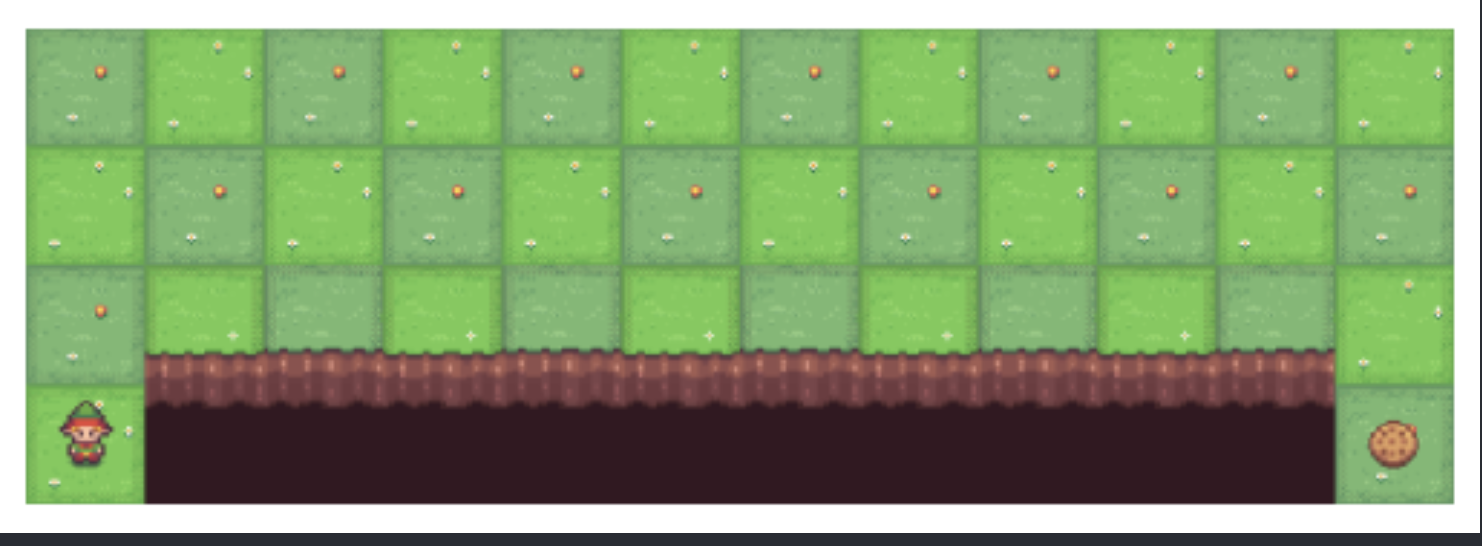
Understanding the Environment
The environment is a 4 x 12 gridworld.
- The agent starts at the bottom-left corner
- The goal is at the bottom-right corner
- The cells between them on the bottom row are the cliff
- If the agent steps into the cliff, it receives a large negative reward and goes to the starting state
Rewards and penalties
- Each normal step gives a reward of -1
- Falling into the cliff gives a reward of -100
- The episode ends when the agent reaches the goal
Initialize the Environment
We initialize the CliffWalking stochastic environment.
This environment has four actions:
0: move left1: move down2: move right3: move up
The state is represented as a single integer corresponding to the agent’s location in the grid.
For example:
- the start state is
36, which corresponds to row3, column0 - the goal state is
47, which corresponds to row3, column11
env = gym.make("CliffWalking-v1", render_mode="rgb_array", is_slippery=True)
Environment Description
Before training, it helps to understand what the environment returns.
Observation space
There are 3 x 12 + 1 possible states available to the agent.
The agent cannot remain inside the cliff cells, and the goal ends the episode, so the state space includes:
- the first 3 full rows
- the starting bottom-left cell
Each state is encoded as:
state = current_row * ncols + current_col
So if the agent is at row 3 and column 0, the state is:
3 * 12 + 0 = 36
Starting state
The episode begins in state 36.
Reward structure
- Normal move:
-1 - Cliff:
-100
Episode termination
The episode ends when the agent reaches the goal state 47.
Sampling a Trajectory
Because Monte Carlo methods learn from complete episodes, we need to generate a trajectory by following the policy inside the environment.
What happens here:
- Resets the environment to the start state
- Follows the current policy until the episode ends
- Uses epsilon-greedy exploration
- Stores each experience as a tuple:
- current state
- action
- reward
- next state
- done flag
This gives us one full episode that we can later use to compute returns.
Why epsilon is used
If we always follow the current policy exactly, the agent may never explore better actions.
So with probability epsilon, we take a random action. Otherwise, we follow the policy.
def sample_trajectory(policy, env, epsilon=0.1):

    done = False
    trajectory = []
    state, _ = env.reset()

    while not done:

        if np.random.rand() < epsilon:
            action = env.action_space.sample()
        else:
            action = policy[state]

        next_state, reward, done, truncated, _ = env.step(action)
        experience = (state, action, reward, next_state, done)
        trajectory.append(experience)
        state = next_state

    return trajectory
Computing Returns from a Trajectory
Once we have a full trajectory, we need to compute the return for each state-action pair.
The return is:
$G = r_t + \gamma * r_{t+1} + \gamma^2 * r_{t+2} + ..$
This function walks backward through the trajectory to compute those returns.
What happens here:
- Starts from the end of the episode
- Computes discounted return moving backward
- Stores the return at every time step
- Uses first-visit Monte Carlo
- Only keeps the first occurrence of each state-action pair in the episode
This is important because in first-visit Monte Carlo, we only use the first time a state-action pair appears in an episode.
def compute_rewards(trajectory, gamma):

    G = 0
    returns = {}

    for t in reversed(range(len(trajectory))):
        state, action, reward, next_state, done = trajectory[t]
        G = reward + gamma * G
        returns[(state, action)]=G

    return returns
Estimating the Action-Value Function
Now we combine trajectory sampling with return averaging to estimate the Q-function.
This function runs many episodes, collects first-visit returns, and averages them.
What happens here:
- Creates a Q-table with one value per state-action pair
- Creates a dictionary to store all observed returns for each
(state, action) - Repeats for many episodes:
- sample a trajectory
- compute first-visit returns
- store the return for each visited state-action pair
- Finally, compute the average return for each pair
That average becomes the Monte Carlo estimate of Q(s, a).
def monte_carlo_estimation(policy, env, gamma, num_episodes):

    Q = np.zeros((env.observation_space.n, env.action_space.n))
    returns = {(s, a): [] for s in range(env.observation_space.n) for a in range(env.action_space.n)}

    for _ in range(num_episodes):
        trajectory = sample_trajectory(policy, env)
        episode_returns = compute_rewards(trajectory, gamma)
        for (state, action), G in episode_returns.items():
            returns[(state, action)].append(G)

    for (state, action), G_list in returns.items():
        if len(G_list) > 0:
            Q[state, action] = np.mean(G_list)

    return Q
Policy Improvement
Once we have the Q-values, policy improvement becomes simple.
For every state, we choose the action with the highest estimated Q-value.
This makes the policy greedy with respect to the current Monte Carlo estimate.
def policy_imporvement(Q):
    return np.argmax(Q, axis=-1)
Monte Carlo Policy Iteration
Now we put everything together.
This function performs the full Monte Carlo policy iteration loop:
- Start with a random policy
- Estimate Q-values from sampled episodes
- Improve the policy greedily
- Repeat until the policy changes very little
def mc_policy_iteration(env, gamma=0.99, num_episodes=20000):

    policy = np.random.choice(env.action_space.n, size=(env.observation_space.n))

    while True:
        Q = monte_carlo_estimation(policy, env, gamma, num_episodes)
        new_policy = policy_imporvement(Q)
        diff = sum(abs(policy - new_policy))
        print(diff)

        if diff < 3:
            break

        policy = new_policy

    return policy, Q
Running the Algorithm
Now we run the full Monte Carlo policy iteration procedure.
This returns:
- the learned policy
- the estimated Q-table
policy, Q = mc_policy_iteration(env)
Evaluating the Learned Policy
After training, lets evaluate the policy.
This evaluation loop plays many games using the learned policy and counts how often the agent succeeds.
What happens here:
- Runs the environment for many episodes
- Always follows the learned policy
- Tracks total reward
- Stops if the episode finishes or gets truncated
- Counts a run as successful if the total return is better than falling into the cliff immediately
The condition R > -90 is being used as a rough way to identify successful runs.
num_games = 10000
win = 0
max_step = 100

for _ in range(num_games):

    nextstate, _ = env.reset()
    R = 0

    for st in range(max_step):
        action = int(policy[nextstate])
        nextstate, reward, done, truncated, _ = env.step(action)
        R += reward

        if done:
            if R > -90:
                win += 1
            break
Final Result
The agent achieved a 72.5% win rate over 10000 games which is fair enough cause of the stochastic environment. When the agent chooses a direction, it only moves in the intended direction with a probability of $1/3$ while the remaining probability leads to movement in unintended directions.
Main Takeaway
This shows how Monte Carlo control works when we do not directly rely on full model-based Bellman updates.
The key flow is:
- sample trajectories
- compute returns from complete episodes
- estimate Q-values from those returns
- improve the policy greedily
- repeat until the policy stabilizes
Unlike dynamic programming methods, Monte Carlo methods learn from experience rather than directly from transition equations.
Summary
- We used the CliffWalking stochastic environment, where the goal is to reach the destination without falling into the cliff
- We sampled full trajectories using epsilon-greedy exploration
- We computed first-visit Monte Carlo returns
- We estimated
Q(s, a)by averaging returns - We improved the policy using greedy action selection
- We evaluated the learned policy over many games